

FlowMarket! Let’s trade our capabilities !
More practical : let’s sell our N8N workflows, one run at a time.
Contents
For years, the API economy has had a quiet flaw baked into its foundation:
you can’t sell small units of value separately.
Mainly due to payment fees.
Visa has millicents costs per transaction, same as blockchains like Solana. The (FIAT) payment provider often charges 15-30 cents transaction fees on top of that, they have to run a full accounting system and that comes at a cost. As a result, anything below two dollars on the web breaks the deal. No customer wants to pay 50 cents for something that costs 25 cents. And no company can afford 50% transaction fees. So it’s no deal. “Not sold separately”.
API calls often cost millicents a piece.
Subscriptions and credits became the default workaround.
So we ended up with a landscape of SaaS tools where you don’t pay for what you use, but for what you might use. Or worse, what other customers use. SaaS is a 500 to 700 billion dollar global market. Half of the SaaS licenses are hardly ever used.
Apart from the 50% unused licenses, 70% of the users only use a few features. But they pay for the development and maintenance of the full app, for all other user niches the company attracts to get enough paying customers to keep the business running. You basically pay for their usage.
That’s a 250-350 billion dollar inefficiency. That amounts to 0.25% of global GDP.
It isn’t just inefficient.
It’s an unneccessary loss for a world that is rapidly becoming agent-driven. We have the techniques to solve this.
I made FlowMarket last week: Sell any N8N workflow for cents, instantly executed or on a schedule. Ordered and paid by Claws/agents or humans. Delivered by email, and downloadable through the api or web UI.
No subscriptions, just pay and get the goodies.
FlowMarket: monetize your flows
Today, most automation and API services can’t sell below a few dollars, so everything becomes a monthly plan. That forces users and AI agents to subscribe to tools they barely use, just to access a single function.
FlowMarket removes that constraint.
Developers can publish workflows such as N8N automations, data enrichments, or AI tasks and price them at cents, like $0.02 or $0.30 per execution. Buyers, including AI agents, can discover these flows, pay instantly using USDC on Solana, and receive results within seconds.
No hassle, no registration, no OAuth, no elaborate checkout flows with addresses and names. Just request, pay, execute. The seller receives the payment and you or your agent receive the assets.
This unlocks a new model: instead of subscribing to software, you pay per single workflow call. Agents are no longer limited to the tools their owner subscribed to. They can tap into an emerging global marketplace of capabilities and execute exactly what they need, when they need it, at their own prefered price-quality level, within their own budget.
In practice, this means businesses can piggyback on each other’s infrastructure, turning workflows into tradable, reusable economic units.
The FlowMarket makes automation liquid, composable, and for the builders directly monetizable.
The Subscription Trap
Today, if an AI agent wants to execute a task, it runs into a wall:
- Need data enrichment? → subscribe
- Need automation? → subscribe
- Need a workflow? → subscribe
That job will require another 50 dollar a month subscription, even if the actual value of the task is $0.10 and you only need it once a month. But up till now, your task is not sold separately. Instead of fluid, just-in-time on-demand execution, we get locked-in stacks of recurring costs, a lot of overspending.
Enter FlowMarket
The FlowMarket flips this model on its head.
It lets developers and companies monetize individual N8N workflows directly
and allows agents to buy and execute them in real time.
No subscriptions.
No accounts.
No elaborate checkout flows with cards and forms.
Just:
- request
- price
- payment
- execution
All within seconds.
If Stripe made payments programmable for humans,
FlowMarket makes them native to machines.
We cut out the middle man and their accounting system cost. We ditch the 25 to 30 cent accounting overhead per sale of Stripe and Paypal and use a blockchain for the accounting. With Solana we get ~0,1 cent fees, comparable to bare knuckles Visa. I will still charge 0,5 cents per call for infra cost, same as N8N, and apply a percentage fee.
But I don’t need to charge the 25 cents and that means we can trade starting from 2 cents.
The Shift: From SaaS to CaaS
Instead of:
“Which tools do I subscribe to?”
The question becomes:
“Which flows do I want to execute right now?”
A $0.25 lead enrichment.
A $3.00 video ad
A $0.10 list of 1000 companies with Google Business Info per keyword (I made that flow yesterday)
Each one:
- discoverable
- verifiable
- payable on-chain
- instantly delivered
What do you or your agent actually need at that moment ?
Not so much the product. The product is the underlying need, but at that moment, your agents need the capability. The agent needs access to a resource or or means to provide in the data or product.
We can give all the Claws all the skills but the skill often requires the subscription to enable it. So we can share and sell the capabilties, we can rent out our DeFi Agents per hour :), or sell our workflows.
It’s a different way of doing business on the web. Capability-as-a-Service.
The Magic Moment
Picture this:
At 03:12 AM, a sales agent detects a new batch of inbound leads from China.
It doesn’t have a subscription to enrichment tools.
It doesn’t need one.
Instead, it scans FlowMarket, finds the best-performing best-fit workflow, Chinese marketing data, and executes it 200 times in parallel.
Each run costs only a few cents.
Each result is delivered within seconds.
Each transaction is settled on-chain.
A five dollar job. Fiverr for Agents.
No humans.
No contracts.
No dashboards.
Just outcome. And therefor, income. Uninterruptable. Bots and agents doing 24/7 worldwide business on the blockchain.
Piggyback Economics
With FlowMarket, you’re no longer limited to the tools your company subscribes to.
You can piggyback on the subscriptions of others, your business partners, through their published workflows.
Someone else pays for the heavy infrastructure, and looks after the workflow development and upkeep.
You pay per execution.
A provider can sell the same workflow to anyone else and spread the cost.
One subscription.
Many downstream consumers.
Monetized per use.
Customers can drop the SaaS subscriptions, they now have you a Pay Per Use provider.
Why This Wasn’t Possible Before
Two blockers made this model impractical:
- Payment friction
Traditional rails make sub-$1 transactions economically impossible. - Trust overhead
You had to rely on platforms, accounts, or opaque integrations.
FlowMarket removes both:
- USDC on Solana enables microtransactions with negligible cost
- On-chain verification + cryptographic proofs replace trust with math
Every transaction is:
- validated
- split atomically
- delivered automatically
No escrow. No delays. No ambiguity.
Machine Economy First
FlowMarket was first built for agents. I added a UI for humans. Developing for agents changes the design space
Instead of ‘UI First’:
- UX flows
- onboarding funnels
- subscription tiers
…and a giant helpdesk organisation…
You get:
- protocol-level blockchain payments (HTTP 402)
- machine-readable pricing
- autonomous execution
…and your agents will mainly interact with the payment gateway whilst you chat with it.
The Real Implication
When workflows become the unit of commerce, a few things happen:
1. SaaS starts to dissolve
Why subscribe to a 50 dollar a month tool when you need a 10 cent product once a week ?
2. APIs become economic actors
It turns your WordPress blog into a Automated Candy Store. Every API endpoint can price itself. Every call becomes a transaction.
3. Agents gain leverage
They are no longer constrained by pre-approved pre-installed tools.
They operate freely on open markets of capability.
A Different Kind of Trust
There’s a deeper layer here.
Today, platforms simulate trust through branding, policies, and control.
FlowMarket replaces that with:
- cryptographic identity (for sellers: linked to the owner KYC)
- verifiable transactions
- auditable execution
It’s a shift from:
“you’ll have to trust us”
to:
“check and verify the proof here”
Where This Leads
We are moving toward a world where:
- companies don’t manage sheets of subscriptions
- work and value is exchanged globally in real time, per work unit
The question will no longer be:
“Which software do you use?”
But:
“Who handles your workflows ?”
CBDC
I estimate in five years we’ll have a Digital Dollar and Digital Euro, perhaps as stablecoins. That will allow us to move from Solana to official chains/systems. Hopefully with the same milicent fees. I’ll have a ready to run battle tested payment system waiting for them.
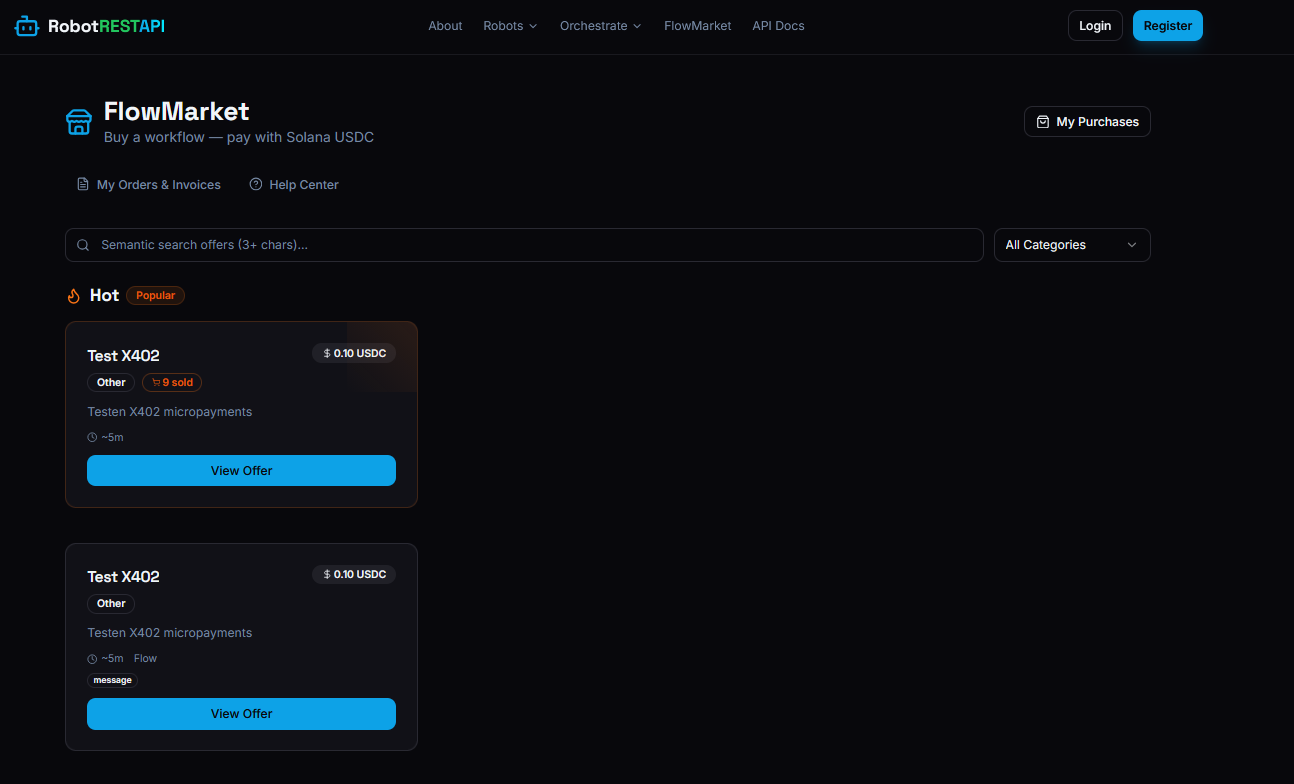
The FlowMarket is already live.
Not as a promise.
As infrastructure.
Once you see workflows as tradable capabilities, executable units of work and value,
it becomes hard to unsee it.
It’s a next step in the emerging agent market. The skill and subscription are for the specialized agent, they form the capabilities of the agent. That is what we sell to the consumers and businesses. Capabilities. Sold as units of work.
Empowerment. We can all soon use and try out all kinds of magical AI powers, a penny a piece, no hassle….
I’ll be looking for some N8N builders with a Claw and a Phantom wallet to help test the system and iron out the glitches. Once we finished testing it, we can start selling our work.