

I just published this in Dutch, I thought maybe the English speaking folk might find this interesting as well. It isn’t advice but a recap of a few weeks of discovering and exploring the emerging humanoid robot market.
Huisrobot.com was #1 in Google Netherlands yesterday, the site is two weeks old. It isn’t much yet, but hey, we have Real Robots !
“C3PO Lives !”
Cool, he ?
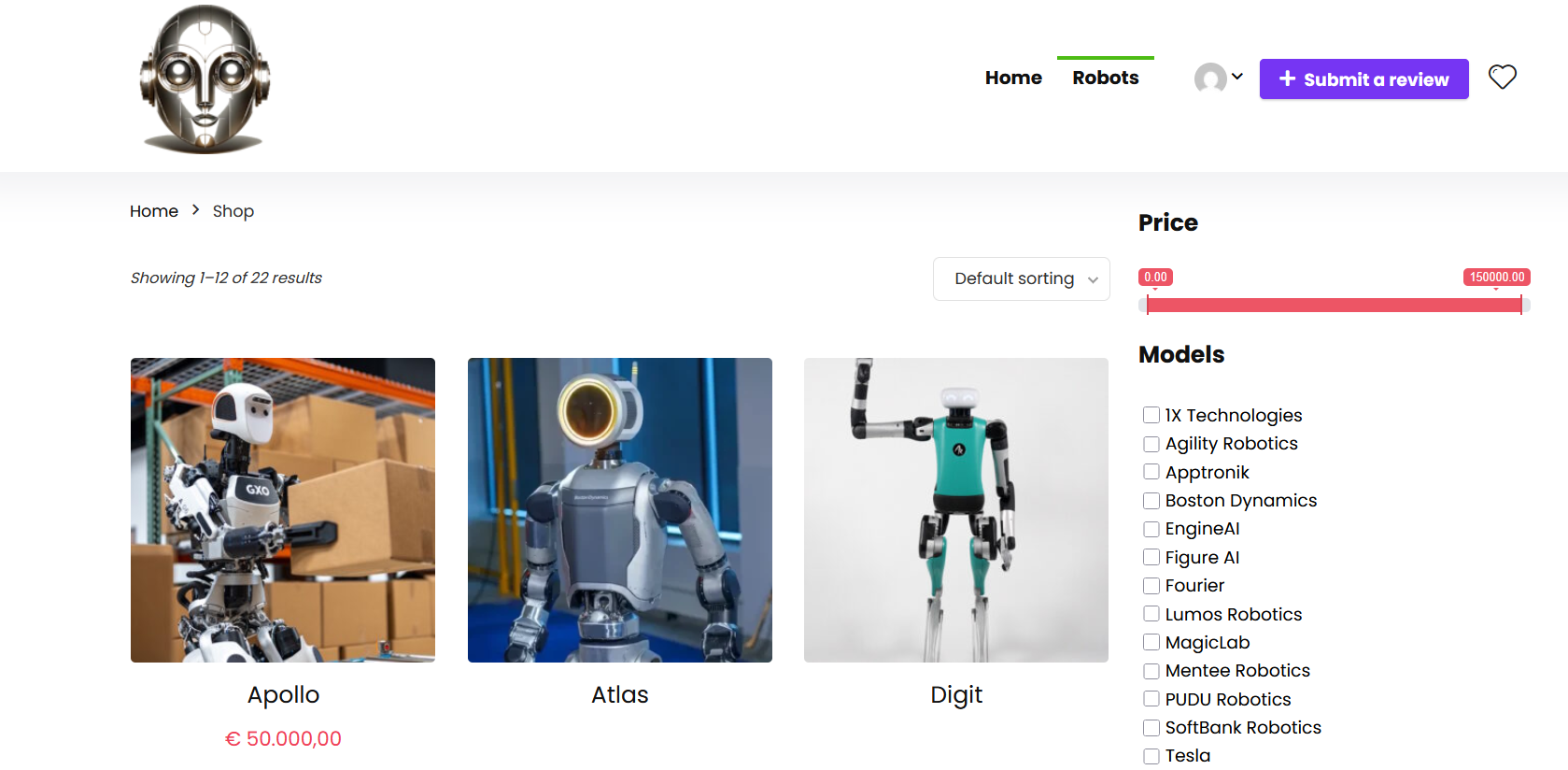
Over the past few weeks, I’ve been diving into humanoid robots. Some robotics purists consider humanoids a hype, while others see them as the next major market.
New market : Humanoids
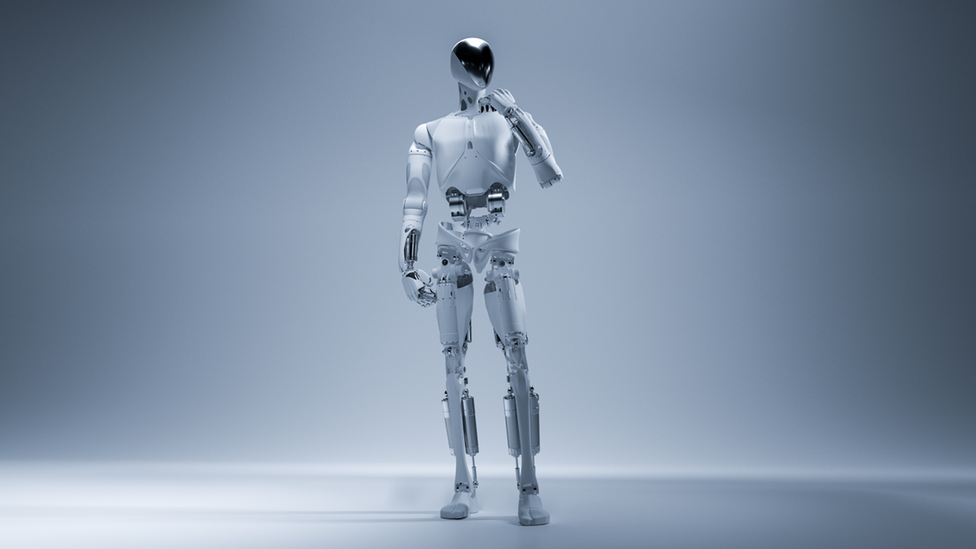
A humanoid is a general-purpose robotic platform with a human form, designed to take over physical labor in human environments, where the investment value lies primarily in software, autonomy, and scalability rather than in the mechanical end product.
II assume that within five years the humanoid robot market will become mainstream, penetrating not only the enterprise market but also the consumer market, and that within 30 years this market will be larger than the automotive industry.
In promotional narratives, the comparison is often framed as follows: a human worker costs at least 30,000 per year and works around 1,700 hours. That comes down to 18.50 per hour. A robot costs that same 30,000 as a one-time purchase and works for 10 years, 24 hours a day, roughly 80,000 hours for 30,000, which is about 42 cents per hour. Add electricity costs, but those are negligible for now. A home robot like NEO might consume around one dollar of electricity per day, roughly 4 cents per hour.
So you will soon be paying either 18.50 or 0.50 per hour for the same work: order picking, cleaning, shelf stocking, serving drinks, hanging coats, light gardening, and municipal green maintenance. And ultimately, your customers pay for that difference.
This enables price reductions of up to 20 percent. Labor costs make up roughly 40 percent of total costs, with an additional 10 percent profit margin on top. If you can shift 50 percent of that workload to robots at roughly 3 percent of the cost (0.50 divided by 18.50 is about 3 percent), you free up around 18.5 percent in costs. With the profit multiplier included, consumers end up paying on average 20 percent less for many products.
You sell your beer for 2.50, or you are forced to sell it for 3.00. Figure out what happened next. With a disruption like this, companies have no real choice: they either adopt it or lose customers and revenue, and eventually go bankrupt.
Likewise, around the house, the robot does chores that would cost you 25-30 an hour, the cleaning lady every week. That is a big winner for a lot of people, it can babysit, it can cook for you, keep you company, do your accounting, it supplies security (you can cancel your 50/mo security subscription). Assuming robots last 10 years, at 20.000, they cost 175 per month ex interest, assume 250 per month including interest. For a lot of families that’s interesting for a 24/7 digital housekeeper.
Investments in Robots
There was a Dutch article on IEX.nl (for investors) this week that highlighted some robotics suppliers. I did not really encounter those in the humanoid narrative. In the West, humanoid companies are almost all still startups, largely emerging from universities, NASA, and similar institutions. Many of them are only three to five years old and are not publicly listed yet.
In China, UBTech (2012) and Unitree (2016) are already publicly traded and valued around 8 billion dollars each. China designated humanoid robotics as one of its ten strategic priority programs and has invested an estimated 150 to 250 billion in the sector over recent years. What happens at regional and provincial levels is not fully visible in national statistics. They currently have a healthy emerging internal market for home robotics and robots.
In the West, Tesla is involved, as are BMW and all major automotive manufacturers, including Volvo and Mercedes. Amazon, Google, AI-focused companies. ARK Invest are also active in this space. However, the sector is still largely in the seed phase, driven by venture capital rounds.
Musk is set to receive a 1,000 billion bonus if he succeeds in robotizing Tesla’s factories before 2030, and he expects to produce one million Optimus robots per year by then. In 2024, Elon stated that Optimus alone could potentially increase Tesla’s valuation from 1,000 to 25,000 billion. Expectations are enormous. Those expectations are widespread, and the 1,000 billion bonus for Musk is a particularly eye-catching yummie.
Through Tesla, investors can gain relatively easy exposure to humanoids.
Beyond that, however, there are no publicly listed humanoid startups in the West yet. As an investor at this stage, you can instead look at various ETFs:
1. ARK Artificial Intelligence & Robotics UCITS ETF (ARKI)
• Theme: AI incl. robotica/autonomous technologies (EU-version van ARK’s ETF)
• ISIN: IE0003A512E4
• Traded at. Xetra, LSE, Amsterdam, Borsa Italiana a.o.
2. iShares Automation & Robotics UCITS ETF
• Theme: worldwide robotics and automation
• ISIN (accumulerend): IE00BYZK4552
• Broad coverage of tech and industrials (Nvidia, ABB, Tesla)
3. Amundi MSCI Robotics & AI ESG Screened UCITS ETF
• Theme: robots + AI with ESG-filter (durable)
• ISIN: LU1861132840
• Index-tracking ETF
4. L&G Artificial Intelligence UCITS ETF
• Theme: AI & robotics-related companies
• ISIN: IE00BK5BCD43
• Main focus is on AI
5. Lyxor/MSCI Robotics & AI UCITS ETF (ROAI)
• Thema: robotics & AI via MSCI-index
• ISIN: LU1838002480
6. Global X Robotics & Artificial Intelligence UCITS ETF
• Theme: robotics + AI worldwide
• ISIN: IE00BLCHJB90
• also traded on European exchanges
ARK Invest is an interesting option, led by Cathie Wood. She identified the potential of Bitcoin and Ethereum early on as well. She is not a short-term speculator but invests with a long-term horizon. ARK focuses on high-tech growth markets and offers a dedicated ETF for each theme, allowing retail investors to effectively participate in what would otherwise be venture-capital-style exposure.
1X Technologies was valued at 1 billion in a seed round in January ’25, and just one year later, after the pre-sales of the NEO home robot began, it is reportedly valued at 10 billion as of January ’26. That is a tenfold increase in a single year. Newly born unicorns are already happily bounding through the fields left and right, including UBTech and Unitree.
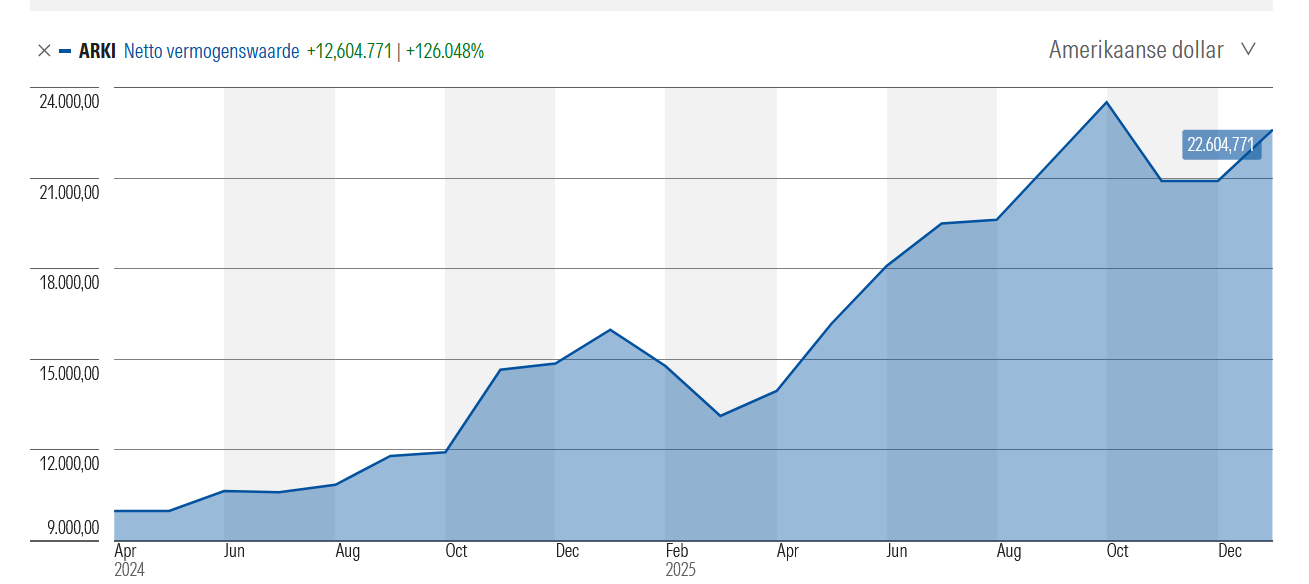
I briefly checked the performance of the ARKI ETF , and it looks strong: up 126 percent in about a year and a half. That may be, alongside Tesla, one of the easiest ways for retail investors to gain exposure right now. But of course, that is something to discuss with your financial consultant. I am not an advisor, and I do not invest in stocks or companies myself.
How big is this market going to get ?
Market estimate
Very roughly speaking, McKinsey (2017) reported that 50 to 60 percent of today’s task load could eventually be performed by AI and robots, but that should be viewed as a process unfolding over roughly 50 years (my estimate). In their 2025 report, they state that with currently demonstrated technology, 5 percent of tasks can be fully automated and 60 percent can be automated for about one third, amounting to roughly 20 percent of total task load.
These figures do not contradict each other. Around 25 percent is already achievable with existing technology. Our tech wizards are actively building, and the truly large budgets are only now starting to flow into the market. So I expect that the remaining 25 percent will be quite feasible over time.
That is the enterprise market. Companies have to compete, and competition will drive adoption. This could lead to an initial wave of around 10 percent task displacement over the next five years through AI agents. That can happen quickly. You build an agent centrally in the cloud, deploy it online, and it can be used globally almost instantly to replace human labor.
Automating the remaining 50 percent of task load will take much longer. That represents roughly 1.75 billion jobs’ worth of tasks, and you would need to build around one billion robots to take over that work. One by one. That simply takes time. If you assume a pace of about 1 percent per year, that means an average displacement of around 17.5 million jobs’ worth of task load per year globally over the next 50 years.
I estimate that by 2075, half of all households will own a home robot. That corresponds to roughly 2 billion households worldwide (two parents and two children on average, meaning 2 billion households across 8 billion people), resulting in the purchase of about 1 billion robots.
You can therefore assume that over the next 50 years we will produce around 2 billion robots in total, averaging 40 million per year. At a price point of 25,000 per unit, that represents a market of 1,000 billion per year, a scale we would need to reach by around 2050.
I checked other well-known forecasts as well. Bank of America projects around 3 billion robots by 2060, largely in and around the home. I am more conservative at 2 billion. Other forecasts, such as Astute, focus on 2035 and project global robotics revenue growth from 50 to 200 billion by then. If that growth rate continues (roughly fourfold per decade), you reach around 800 billion by 2045, which aligns with the Bank of America outlook.
Dutch market
There is already a household robotics market in the Netherlands of roughly 150 to 200 million annually, including Roomba’s and lawn mowers, but also robotic arms and surgical robots. That figure does not yet include humanoids.
In the Netherlands, task displacement would affect roughly 5 million jobs’ worth of task load. You could replace that with, say, 4 million robots. In addition, 4 million households would each purchase one, resulting in a total of about 8 million robots over a 50-year period, or roughly 160,000 robots per year. At an entry price of 25,000 per unit, that translates to around 4 billion in average annual new sales.
A significant portion of this will be leased, especially in the enterprise sector. After five to ten years, replacement cycles kick in and a second-hand market emerges. Over time, that effectively doubles the market size of the industry. But that only happens after about 20 years. At that point, you are looking at 6 to 8 billion in annual robotics trade in the Netherlands.
On top of that, robots become part of culture and status: fashion, films, series, books, clothing, music. Add the usual adjacent and supplier markets: skins, mods, fashion, personalization, alongside standard maintenance, services, spare parts, training, tooling. Everything has to be demonstrated and promoted, certified and reviewed, registered, insured, and financed.
The industry could realistically move toward 10 billion per year in the Netherlands alone. It becomes the younger sibling of the automotive market, and with robotaxis it partially absorbs that market as well. Last year, 360,000 new cars were sold in the Netherlands. Robots are likely heading toward similar volumes over time.
Worldwide the market might grow to 2.500 billion per year by 2075.
Robot Sniper
I like sniping. I did that in crypto as well, buying Ether at 85 cents back in 2014. I don’t have much cash, so I look for the x100, x1000 opportunities. I look for new markets where almost nothing is being sold yet, that have moved beyond prototyping, and that are starting to head toward the consumer market, the broader exposure. Like crypto in 2014.
This could be one of those markets. The manufacturers are past the prototype phase and are starting up production.
I started thinking about domain names.
Homerobot.com is listed for sale at 2.5 million. The Dutch language market is roughly 25 times smaller than English, so huisrobot.nl should still be worth around 100K, and huisrobot.com perhaps 50K or even 100K if the site ranks number one.
All English-language robot domains are taken, all the way down to robotpoop.com. The best Dutch-language ones are gone as well: robotkopen, robothuren, huisrobot.nl. But some Dutch-language dot-com domains were still available, like huisrobot.com. And there were still some nice dot-nl domains. They cost 3 euros to register and about 7 per year to renew, so I bought around 50 of them: robotverzekering, robotlening, robotnieuws, robotkrant, robotscout. That’s about 150 euros upfront and roughly 350 per year to keep them.
This year I’ll put a few of them online with a cloud database behind them. Robots in the storefront everywhere, videos later, news, reviews. There is no competition yet, so I immediately rank number one with my robot sites.
….and then the doubt kicks in. Because there is no competition. If no one else sees it, you are either a visionary and smart for moving early, or many others already looked at it, mainly the SEO and marketing professionals, and decided these domains were not even worth the 3-euro gamble. That gnawing uncertainty is part of the game ‘sniper !’. You’ll know when the market opens…
KEEP CALM AND HODL !
For now, I’ll suffer the FUD and I’ll calmly and stoically keep building the database, expanding it, improving the websites and taking up position, building trust and authority and backlinks. We’ll see what happens over the coming years. I just think robots are cool, so I’m having a great time regardless. I was addicted to RoboTech as a kid.
